


When we think of Italian wine, our minds often drift toward the rolling hills of Tuscany or the sun-drenched coastlines of Sicily. Yet tucked away in the country’s far north-eastern corner, between the Alps and the Adriatic, lies one of Italy’s most fascinating and refined wine regions — Friuli Venezia Giulia. A region where ancient history, diverse geography, and modern innovation converge beautifully in every glass.
A Region Steeped in History
The name Friuli Venezia Giulia traces its origins back to Julius Caesar, who gave the name Forum Julii to what is now the town of Cividale del Friuli. This Roman legacy still echoes through the area, which for centuries has served as a crossroads of cultures — Italian, Austrian, and Slavic — shaping not just its cuisine and architecture, but also its distinctive approach to winemaking.
The early days of viticulture here were deeply intertwined with the monastic tradition. Local monks began cultivating vines at the edges of the forests, cleverly training them to wrap around tree trunks for support — an ingenious precursor to modern vine trellising. By the 1960s, the region’s focus leaned heavily toward red wine production, but it was soon after that a quiet revolution began tilting the balance towards white wine.
The Modern Friulian Renaissance
Today, Friuli Venezia Giulia’s wines represent just 5% of Italy’s total wine production, yet their quality and innovation are world-renowned. The region’s two most prestigious denominations — DOC Collio and DOC Friuli Colli Orientali — have become benchmarks for elegance, purity, and expression of terroir.
Visionary producers such as Mario Schiopetto helped to redefine Friulian winemaking in the mid-20th century. Schiopetto championed cleaner, fresher white wines with remarkable aromatic clarity, setting a new standard for modern Italian whites. His influence is still felt today, alongside a new generation of winemakers who continue to balance tradition and experimentation.
Terroir and Climate – A Perfect Balance
The landscape of Friuli Venezia Giulia is as varied as its wines. To the north and east, the Julian Alps and Prealps form a protective barrier, while to the south, the Adriatic Sea tempers the climate with warm breezes. This unique geography gives the region both continental and Mediterranean characteristics, offering sun-soaked days and cool nights — ideal conditions for preserving acidity and aromatic precision.
Friulian vineyards benefit from abundant sunlight, mineral-rich soils, and excellent drainage. These elements combine to produce wines with notable structure, freshness, and balance — wines that truly reflect their place of origin.
Ancient Methods, Modern Expressions
One of Friuli’s most distinctive traditions is skin maceration, a practice often used for white wines, giving them a deeper colour and layered texture. Many winemakers have revived the use of amphorae — clay vessels dating back to ancient times — for fermentation and ageing. This technique allows for a gentle exchange with oxygen and imparts remarkable depth and complexity to the wines.
There are generally two stylistic directions in Friulian winemaking today:
- The “single” or classic wines, focused on purity, precision, and varietal expression.
- The “post-modern” or natural wines, which experiment with skin contact, spontaneous fermentation, and amphora ageing.
Together, they embody the dual spirit of Friuli Venezia Giulia — deeply rooted in history, yet always forward-looking.
Grapes of the Region
Friuli Venezia Giulia is home to an impressive array of indigenous and international grape varieties. Among its native stars are:
- Friulano – elegant and slightly almond-scented, often considered the region’s signature white grape.
- Ribolla Gialla – crisp, citrusy, and increasingly used for skin-contact “orange” wines.
- Refosco del Pedúncolo Rosso – a deeply coloured red with vibrant acidity and dark fruit notes.
The region’s proximity to Austria has also left its mark, with widespread plantings of Riesling, Riesling Italico, Traminer Aromatico, and Müller-Thurgau, reflecting its cross-border influences.
New Trends: Prosecco and Rosé
While Friuli Venezia Giulia has long been celebrated for its whites, new trends are bubbling up — quite literally. Prosecco and rosé wines are gaining increasing prominence, appealing to contemporary tastes while still showcasing Friuli’s characteristic finesse and freshness.
A Region Worth Discovering — in Every Sip
For Swedish wine enthusiasts seeking something beyond the familiar, Friuli Venezia Giulia offers an exciting world of diversity and depth. Its wines tell stories — of ancient forests and modern amphorae, of Alpine breezes and Adriatic light, of innovation built upon centuries of tradition.
So next time you’re exploring the Italian section at your local Systembolaget or restaurant, take a moment to breathe in the aromas of Friuli Venezia Giulia. You might just discover Italy’s most quietly extraordinary wines.
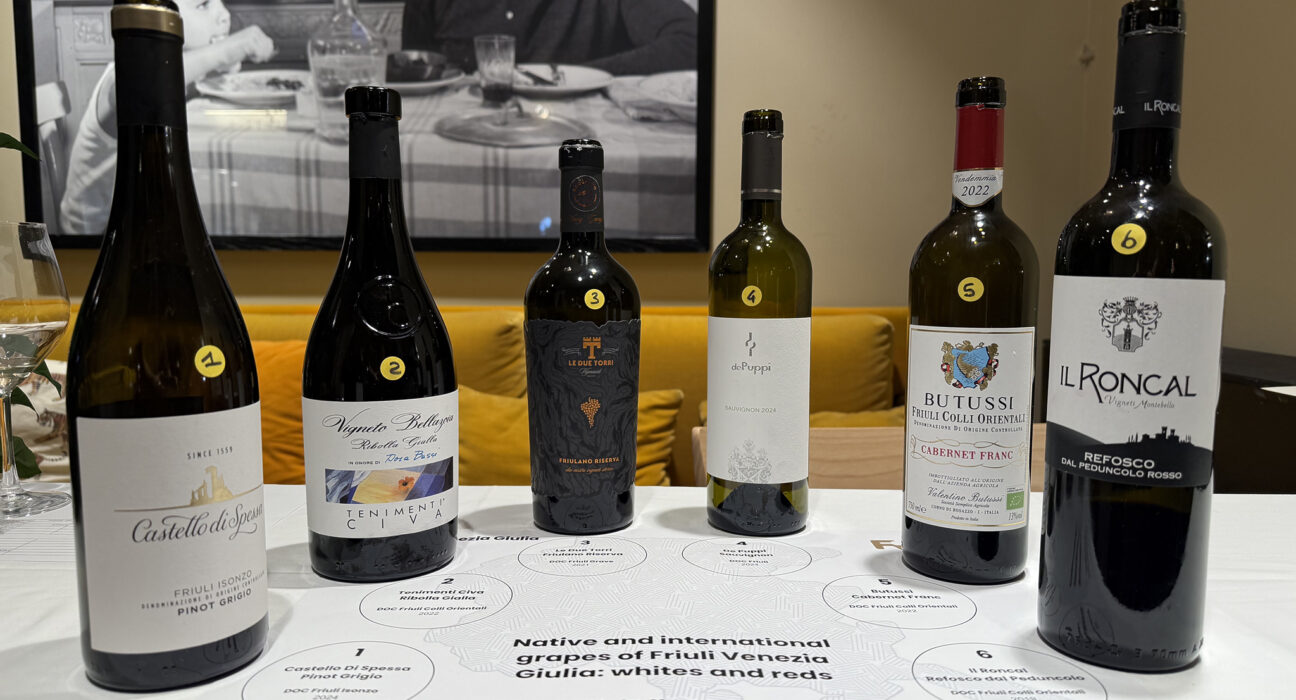
And just for extra inspiration here are a few hand picked recommendations which we here at Your Living City had the pleasure of tasting at the Friuli Venezia Giulia masterclass to which we were invited. You can order these wines online and pick them up at your local Systembolaget.
- Il RoncalRefosco dal Peduncolo Rosso, 2018
Nr 7394401
Price 214 kr
Characteristics: Intense and pleasant with hintws of wild blackberry and undergrowth. Saboury in the mouth, slightly tannic, full bodied, warm, with a persistent and pleasant aftertaste or juicy black berries. Suitable for ageing. This wine is an ideal accompaniment with fat and stewed meat. It goes very well with the typical dishes of the Friuli Venezia Giulia region.
- Ribolla GiallaFriuli Colli Orientali, 2020
Nr 5233601
Price 189 kr
Characteristics: An easy to drink wine with a fresh and fruity taste of citrus and green apples. The wine is perfect to serve with fish and shellfish or as an aperitif. It is also an exciting grape to explore for those who want to try something new. Feel free to try this wine from one of the most exciting wine regions in Italy.
- Il RoncalFriulano, 2022
Nr 7039401
Price 199 kr
Characteristics: Straw yellow colour with green hues. Fine delicate, intensely scented of wild flowers, dry and refreshing, soft and smooth, with a neat taste of bitter almond. This wine is an ideal accompaniment to light hors-d’oeuvre, noodle soups, cheeses and ham.
- Friuli Colli OrientaliSauvignon, 2022
Nr 7850901
Price 201 kr
Characteristics: Pale straw yellow in color, the nose reveals a bouquet of pepper and tomato leaf aromas, with mineral notes. The palate is fresh, with a fairly persistent finish. Excellent with asparagus, omelettes, fried fish and vegetables, and shellfish.
- Il Roncal Roseum Spumante Rosé
Nr 7273501
Price 199 kr
Characteristics: Light pink colour; fine, persistent perlage. On the nose, fresh notes of berries – raspberry and blueberry above all – as well as pleasant hints of ripe pomegranate stand out. Lively on the palate and with good aromatic persistence, it closes with an elegant softness. Excellent as aperitif, good pairing with delicate fish-based courses and creamy desserts.